The Safety First Team welcomes Airbus DS as new contributor to the contents of our magazine in the field of the Military Aviation. Embracing the firm commitment of Airbus Group to Product and Flight Safety, Airbus DS will cover several subjects related to the Aviation Safety from a military perspective. This contribution starts with an article which introduces the Aerial Refuelling as an essential capability for the Air Power projection. This article is the beginning of a Series of articles which will describe how Airbus DS has approached to the Aerial Refuelling and how the associated Safety challenges have been overcome.
AERIAL REFUELLING, AN ESSENTIAL CAPABILITY FOR THE AIR POWER PROJECTION
Since the earliest days of Aviation, the problem of range extension for aircraft was contemplated. Range extension would allow aircraft to fly large distances without landing for services, enabling a more efficient Mission management. A solution to range extension by Air-To-Air Refuelling raised as the best option, in terms of operability, since the very beginning.
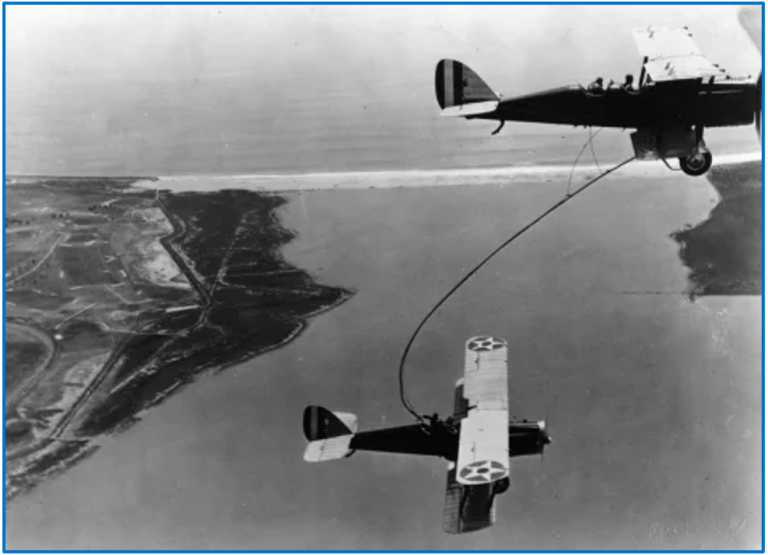
The first successful aerial refuelling took place on June 27, 1923, when a DH-4B, Air Service serial number 23-462, carrying Lieutenants Virgil S. Hine and Frank W. Seifert passed gasoline through a hose to another DH-4B which was flying beneath them carrying Lieutenants Lowell H. Smith and John P. Richter. Hine and Smith piloted their respective airplanes while Seifert and Richter handled the refuelling. A 50-foot (15,24 meter) hose with manually-operated quick-acting valves at each end was used. During the refuelling, 75 gallons (283,9 liters) of gasoline was passed from the tanker to the receiver.
Figure 1 - Air-To-Air Refuelling Raised as the Best Option for Range Extension since the Very Beginning
Since then, Air-To-Air Refuelling has become a cornerstone of modern Air Power. Aerial Tankers play a crucial role in extending the operational range and endurance of aircraft, enabling sustained combat, surveillance, and transport missions across vast distances. These Tankers act as flying gas stations, transferring fuel airborne to a wide range of Receivers such as fighter jets, bombers, heavies and, even, helicopters. By facilitating longer flight durations without the need for landing, Aerial Refuelling enhances Force Projection, rapid response, and global mobility. They are essential for maintaining Air Superiority in both conventional conflicts and asymmetric warfare environments. Additionally, Tankers support Humanitarian Operations, disaster relief, and strategic airlift missions by keeping transport aircraft in the air longer. Recent conflicts and geopolitical developments have reaffirmed the value of refuelling assets in maintaining persistent air presence over contested areas and remote regions. In essence, Aerial Tankers serve as force multipliers, enhancing the agility, resilience, and global responsiveness of Air Power in both Peace time and conflict scenarios.
Today, two (2) systems are available to perform Air-To-Air Refuelling, Probe-and-Drogue and Flying BOOM:
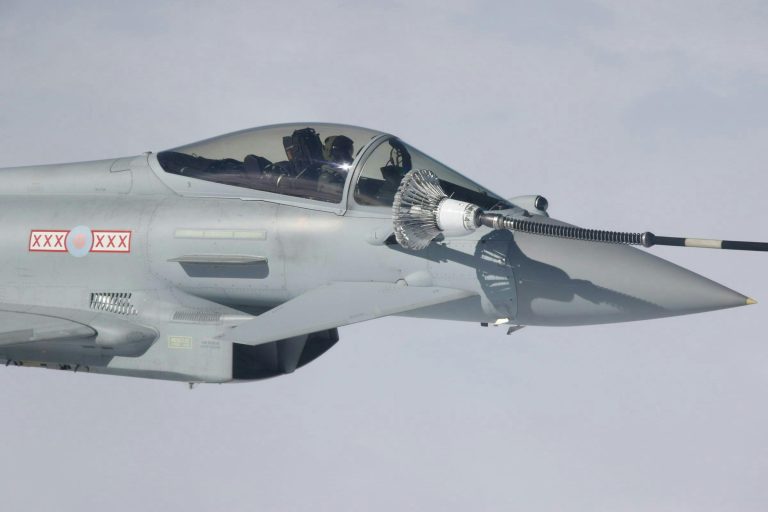
In the Probe-and-Drogue system, the Tanker drops a flexible hose that trails out behind it. On the end it has a basket (drogue). Below, the Receiving aircraft has to perform the contact by itself and, when both the Drogue and the Receiver’s Probe are connected, the refuelling is ready to start.
Figure 2 - Example of Probe-and-Drogue Air-To-Air Refuelling System
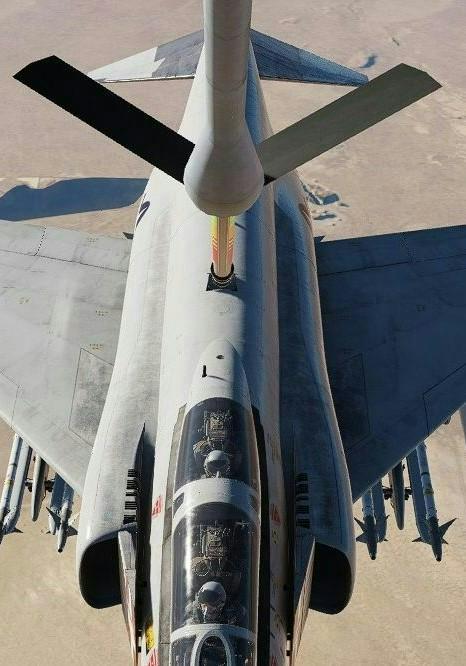
In the Flying BOOM system, a long rigid tube with small airfoils (fins) allows an Operator (Air Refuelling Operator, ARO) on the Tanker plane to guide it down to make contact with the receptacle on the Receiving aircraft, while it flies steadily below the Tanker.
Figure 3 - Example of Flying BOOM Air-To-Air Refuelling System
In the earliest years of 21st century, the military fleet performing Air-To-Air Refuelling and air military transport in the Air Forces was aged and evidenced many of its limitations. When A330 MRTT development was launched, the average age of the tanker fleet in service was over 40 years, mainly based on civil airliners like B-707(KC-135), DC-10 (KC-10) or VC-10; none of them in production at that time.
Along the years, Air Forces worldwide have been demanding the next generation of air tankers with higher capabilities in their central role (refuelling and military transport) and more flexibility in adapting to other roles to meet the demands of the coming decades. In addition to the trend for tankers to operate over greater distances and longer periods than ever before, the requirements were wider than before, being focused on supporting a wide range of expeditionary missions, military and humanitarian.
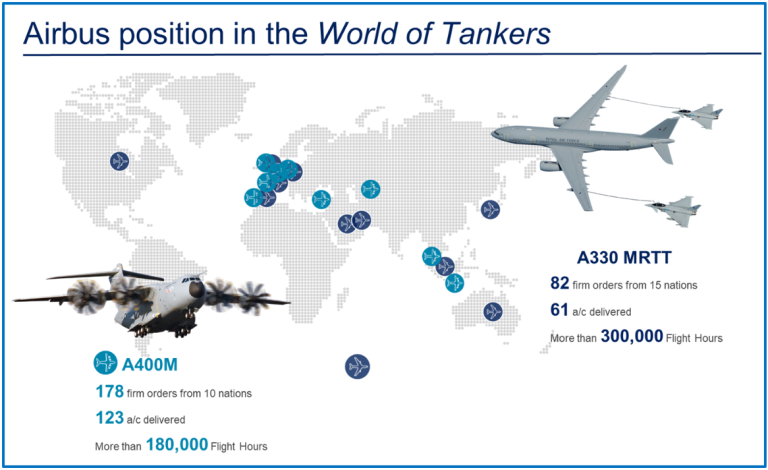
Airbus DS has assumed these challenging requirements in its portfolio and offers two (2) aircraft with Aerial Tanker capabilities: The A400M (fitted with Hose-and-Drogue system) and the A330 MRTT (fitted with Hose-and-Drogue system and/or Flying BOOM).
Figure 4 - Airbus DS Offers Two Aircraft with Aerial Tanker Capabilities (figures as of end 2025)
Apart from the bare operational requirements, Safety is a key aspect of the Air-To-Air Refuelling operations. To the inherent complexity of military flight operations, Air-To-Air Refuelling adds the challenge of two aircraft flying in close proximity, physically connected, and transferring fuel from one to the other. This kind of operation requires close coordination between the tanker and receiver crews, as well as perfect compatibility (functional, structural, and aerodynamic) between both aircraft.
The next articles in this AAR Series will describe how Airbus DS has approached and solved these Safety challenges, providing innovative solutions not only for today’s Air Forces requirements, but also for the requirements to come.
Contributors
FRANCISCO LAGARES
AAR Design Office
PEPE CASADO
Military Aircrafts Accident Investigator Senior Expert
DAVID JIMENEZ
Aviation Safety Digitalization and Enhancement
With special thanks to AAR Engineering and Aviation Safety team at Airbus Defence & Space